
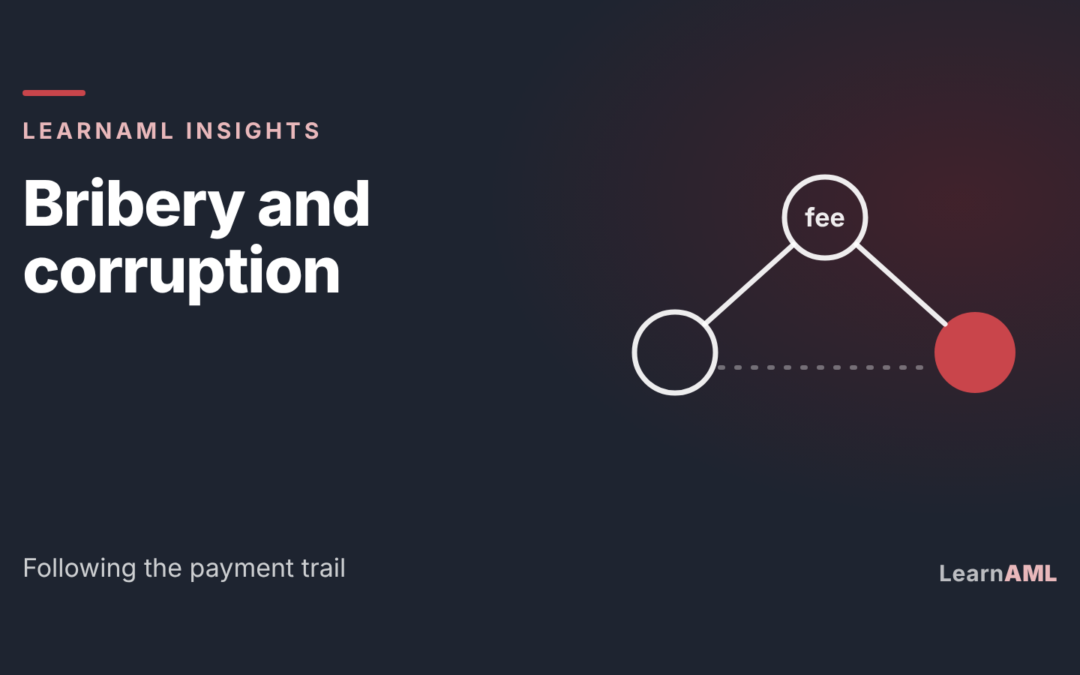
Corruption is often discussed as an ethics or legal problem, but it also shows up in ordinary work: a payment nobody can explain, or a fee with no clear service behind it. People who process payments, onboard customers or review accounts often see these signs before anyone else does.
This article explains how the proceeds of bribery and corruption can move through the financial system, what context should make you look more closely, and what to do when something does not add up. It is general education, not legal advice, and details depend on the law and policies that apply to you.
Why corruption is a money laundering issue
Bribes, kickbacks and secret commissions are payments made to influence a decision or to reward one. Corruption and bribery are widely recognised, including in the FATF Standards, as offences whose proceeds can be laundered. The money paid and received can pass through bank accounts.
Corrupt money rarely stays in one place. A payment may be described as consulting, marketing or commission, sent to an intermediary or a relative rather than the decision-maker, and then moved through several accounts or companies. Later it may be invested in property, businesses or other assets, which makes its origin harder to see.
The corruption itself usually happens far from your desk. What you may see is the payment trail. You do not need to prove bribery. Your part is to notice that something does not fit what you know and pass it on.
Context that calls for closer attention
Some customers and activities carry more corruption risk because they involve decisions made by public bodies or by people with discretion over permits, licences and contracts. Higher risk is not the same as suspicion. It means more care and better records.
Sectors that depend on licences, concessions or public contracts, such as construction, extractives or telecoms, deal with more official decision-making than most. Most businesses in these sectors operate lawfully. The context simply tells you where the purpose of a payment deserves more attention.
A politically exposed person (PEP) is someone who holds, or has held, a prominent public function, together with certain family members and close associates. Being a PEP is not a sign of wrongdoing. It is a risk factor that calls for enhanced due diligence, such as a clearer picture of the source of funds and the purpose of the account, and closer ongoing monitoring.
Intermediaries such as agents, introducers and consultants can create distance between the payer and the decision-maker. Most are entirely legitimate. A clear role, a documented scope of work and a fee that matches the service separate a normal arrangement from one that needs a question. Geography works in a similar way: transparency over public spending and company ownership varies between places, which can affect how much a payment trail tells you. It says nothing about the customer in front of you.
Payment patterns worth a closer look
These are indicators, not proof. Each can have an ordinary explanation, and they matter most when several appear together or when they do not fit what you know about the customer.
- A large “consulting”, “marketing” or “success” fee with no clear scope of work or supporting contract.
- A fee that depends on winning a contract, licence or approval, paid to a recipient with no visible relevant experience.
- A recipient that is newly formed, shows little genuine activity or has ownership that is hard to establish.
- Funds passed on soon after a payment from a public body, split between several recipients in different places.
- Payments timed close to a tender, a licence decision, an inspection or an audit.
- Payments to a personal account, or to a company linked to a relative or associate of a decision-maker.
- Invoices with generic descriptions, or amounts that do not match the work or goods supplied.
- Repeated payments sitting just below an approval limit.
Scenario
Hana Morel is a payments analyst at a small bank. Her customer, Kestrel Ridge Build, has won several local road contracts and is partly owned by a former regional official, which is why the account is already subject to enhanced due diligence. One morning a large payment arrives from a public authority. Within days the company sends two transfers to consultancies formed only months earlier in another jurisdiction, each described simply as “services”. The customer file contains no contract or invoice for either consultancy. Hana does not contact the customer or look for answers herself. She writes down what she saw and why it did not match the file, then sends it to the bank’s MLRO under its escalation procedure.
What matters here: The former official’s ownership is not the concern in itself; it explains why the account gets extra attention. The concern is the combination of quick onward payments, new recipients, vague descriptions and missing documents. Hana does not decide whether this is corruption. She describes the facts and hands them over, and she does not mention it to the customer, because disclosure could amount to tipping off.
What to do when something does not add up
Your role is to notice and report, not to decide whether a crime has taken place. If you are unsure whether to process an item, ask your supervisor or compliance contact how to proceed.
Raise the concern through your institution’s internal reporting procedure, to the MLRO or equivalent compliance contact. Record the facts neutrally: dates, amounts, descriptions, and why the activity did not fit what you know. Avoid conclusions such as “this is a bribe”.
Do not question the customer, warn them or contact counterparties, and do not start your own enquiries beyond your normal duties. Depending on the law that applies to you, disclosing that a concern or report exists may be prohibited as tipping off.
The MLRO or equivalent then decides whether the grounds for a suspicious transaction report are met. The test is usually based on suspicion or reasonable grounds, with wording that depends on the jurisdiction. Be ready for follow-up questions, and do not expect to be told the outcome.
Corruption can also sit inside your own organisation
The same thinking applies to your employer. A supplier that wins repeatedly without competition, a vendor whose address matches a staff address, or hospitality that arrives just before a decision you influence are all reasons to ask a question.
Declare conflicts of interest, record gifts and hospitality as your policy requires, and use the internal reporting or whistleblowing channel if you are worried. Internal cases can also involve staff accounts, so compliance, fraud and HR teams need to share relevant information within the limits the law allows.
Key points
- Corruption creates proceeds that can be moved and disguised, so it is a money laundering concern as well as a conduct one.
- Sector, public contracts, intermediaries and geography raise risk but are not signs of wrongdoing; a PEP calls for enhanced due diligence, not suspicion.
- Payment indicators are reasons to look more closely, and weigh most when several appear together.
- Report concerns internally to the MLRO or equivalent compliance contact, with neutral and factual notes.
- Do not confront the customer or investigate alone, and remember that disclosure may amount to tipping off.
For the wider picture, the free course AML Foundations & Core Concepts covers how money laundering works and what your role is in spotting and reporting it. The Resources page links to official sources and offers the Red Flags Frontline Checklist and an Internal Escalation Note template, both free with a learner account.